GEO Citations ≠ Visibility: An Aimely research study
Citation count and mention rank correlate at r = −0.01 across 358 AI responses. Four of the nine most-mentioned auth brands were never cited once. If you measure AI visibility by citations, you are tracking the wrong signal.
 Tom Walsh
GEO citations vs AI search visibility: two separate signals
In AI search, being cited and being recommended are distinct signals from structurally different systems. That distinction is central to interpreting the Aimely Index dataset for the authentication vertical (16–22 June 2026): citation count has a near-zero correlation with mention rank, measured at Pearson r = −0.01. Four of the nine most-mentioned brands received zero citations across the entire week.
The dataset covers 358 successful AI responses across Claude Sonnet, GPT-5 Chat (version recorded as GPT-5.3 in the Aimely production database — see Methodology), and Google AI Mode, using 20 standardised authentication prompts. After noise removal, it contains 4,677 product mentions across 37 vendors and 152 vendor-attributable citations from a total of 324. The practical implication: teams measuring AI search performance through citation counts are tracking the wrong signal.
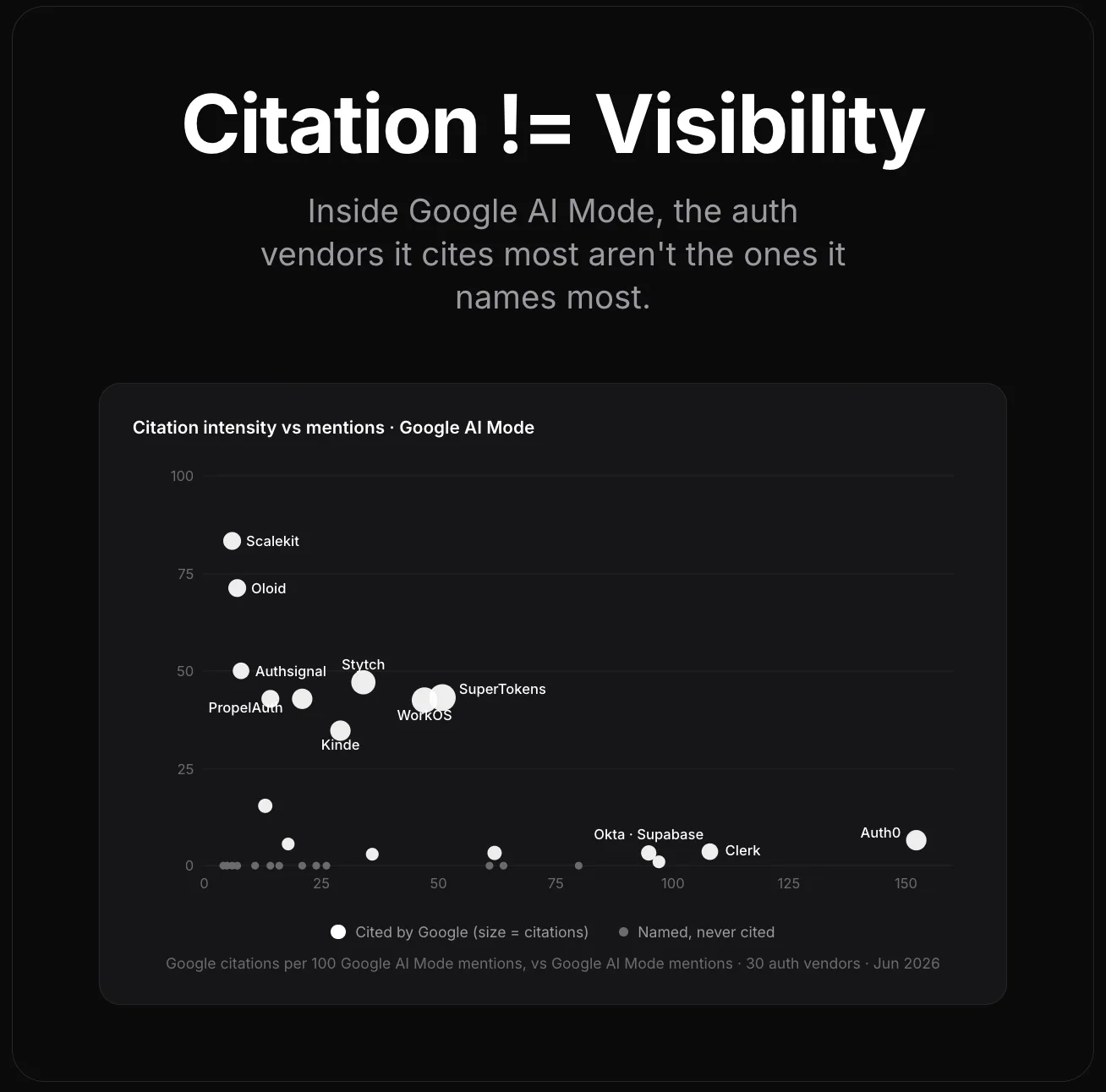
The numbers: mention leaders vs citation leaders
The starkest result in the dataset is a population inversion. The top five vendors by mention volume — Auth0, Clerk, Supabase Auth, Auth.js/NextAuth, and Firebase Auth — hold 51.4% of all product mentions and 72.4% of first-named slots. Their share of vendor citations: 9.9%.
A separate group of 12 high-intensity challengers holds 8.9% of mentions and 9.6% of first-named slots. Their share of vendor citations: 81.6%.
The two groups are nearly mirror images of each other on the citation axis.
The zero-citation incumbents make this concrete. Auth.js/NextAuth received 383 mentions and was named first in 22 responses. Firebase Auth received 374 mentions and was named first in 25 responses. Both scored zero citations for the entire week. A citation-based measurement system would record these two vendors as invisible. The mention data shows they are among the most-recommended products in the category.
The inverse case is just as instructive. SuperTokens ranks first for vendor citations with 22. It ranks 13th for mentions. It appeared as the first-named product in 0.6% of responses. Cerbos collected 18 citations, appeared in 11 mentions, and was named first exactly once.
The dataset shows a systematic divergence between what AI models retrieve from the web and what AI models recommend from memory. Any ranking methodology that conflates these two outputs will misrank the most-recommended brands in a category while surfacing low-recall vendors near the top.
Citation intensity: the metric that reveals the real gap
Raw citation counts are not comparable across vendors with different mention volumes. A vendor with 400 mentions and 4 citations is in a different position from a vendor with 10 mentions and 4 citations. Citation intensity normalises this: citations divided by mentions, multiplied by 100.
The regression across all 37 vendors produces this relationship:
Citation intensity = 116.46 − 54.46 × log₁₀(mentions), r = −0.561, r² = 0.315, n = 37
Every 10x increase in mentions predicts roughly a 54-point drop in citation intensity. The fitted line reaches zero intensity at approximately 137 mentions. Beyond that threshold, vendors are named from model memory with no source retrieval needed.
The contrast across specific vendors illustrates what the regression describes. Auth0 has a citation intensity of 1.7. Clerk sits at 0.7. These are the two most-mentioned vendors in the dataset. At the other end: SuperTokens scores 24.2, Kinde 26.3, PropelAuth 36.0, and Oso 350.0.
Oso's figure warrants a note. Three vendors in the dataset — One Identity, Kisi, and miniOrange — were cited by Google AI Mode but recorded zero product mentions across all 358 responses. They exist in this dataset only as retrieval artefacts. Google fetched their content to answer a query; no model named them from memory. That is the limit case for rented visibility.
High citation intensity is not a sign of GEO success. It signals that a vendor's parametric presence is weak enough that retrieval is doing all the work.
Why the two measures diverge: memory vs retrieval
When Claude Sonnet or GPT-5 names Auth0 or Clerk in response to an authentication prompt, that name comes from model weights. No web request is made. The model has encountered enough content about Auth0 during training that it can answer without fetching anything. This is parametric recall, and it drives mentions and first-named results across the majority of surfaces in this dataset.
When Google AI Mode cites a document, the opposite is happening. The model queries the web, retrieves ranked content, and cites the sources it used. A vendor with weak parametric presence cannot appear in Claude or GPT-5 at all. Its only path to visibility is through content that ranks well enough for retrieval systems to surface it.
This distinction has a name. Low citation intensity, approaching zero, means owned visibility: the model names the brand from memory and needs no external source. High citation intensity means rented visibility: the brand appears because a retrieval system fetched and cited its content. Rented visibility is contingent on continued ranking. If the content drops, the citations stop.
One data point shows why chasing citations specifically is a category error. Across all 324 citations in the dataset, 53% went to non-vendor content. Reddit collected 66 citations. YouTube collected 59. That is more user-generated content cited than any top-four vendor blog combined. A citation count metric conflates a brand being cited with a Reddit thread about that brand being cited — different outcomes with different implications for brand strategy.
What this means for how you measure AI visibility
1. Citation count is not a valid visibility proxy. With r = −0.01 between citation count and mention rank, the two measures are statistically unrelated. Using citations to rank brand performance in AI search will systematically understate the most-recommended brands and overstate vendors with minimal parametric presence.
2. First-named rate is the cleaner primary signal. Each AI response produces one first-named result or none. With a denominator of 358 responses, first-named rate is directly comparable across vendors regardless of how often they appear in multi-brand lists. It answers a specific question: when AI recommends something for this category, whose name comes first?
3. Citation intensity is a diagnostic metric, not an aspirational one. A declining citation intensity score as mention volume grows is the expected pattern — it means the brand is building parametric presence. A persistently high citation intensity score signals dependence on retrieval and should prompt investigation into whether model training data is thin on this brand.
These findings come from a single vertical, a single week, and a US-leaning context. Citations in this dataset are Google AI Mode citations by construction; other retrieval surfaces could produce different distributions. Different categories with lower training data density might show a weaker memory-retrieval split. The findings describe the pattern in this dataset, not a universal law.
Aimely tracks mention rate, visibility score, citations, and sentiment across AI platforms and generates prioritised actions based on that data. Separating memory-based from retrieval-based visibility is exactly the measurement problem those metrics address.
Methodology notes
- Vertical: authentication (query tags: auth, auth-test)
- Schedule: 16–22 June 2026, 6 of 7 days
- Surfaces: Claude Sonnet, GPT-5 Chat (recorded as GPT-5.3 in source DB), Google AI Mode
- Total scheduled cells: 360 | Successful responses: 358
- Raw brand mentions extracted: 5,777 | After noise removal: 4,677
- Total citations: 324 | Vendor-attributable citations: 152